A single overseas supplier failure can stop an entire production line. Freight costs are climbing, lead times are stretching, and trade policy keeps shifting – and most global manufacturing companies are realizing that depending on one distant source is no longer a manageable risk.
Localized manufacturing is the fix: producing or sourcing components closer to the market that needs them, instead of routing everything through a single overseas supplier. This guide covers what it means, how a manufacturing localization strategy actually works step by step, and why India has become one of the strongest options for global OEMs looking to localize components.
In this guide:
- What Is Localized Manufacturing?
- Why Localization Matters Right Now
- How a Manufacturing Localization Strategy Works
- Component Localization in India
- Where Localization Happens: India’s Manufacturing Clusters
- Challenges to Plan For
- Localized Manufacturing vs. Global Sourcing
- How to Start Localizing in India
- Why India Is Gaining Ground
- How Venttup Supports Manufacturing Localization
What Is Localized Manufacturing?
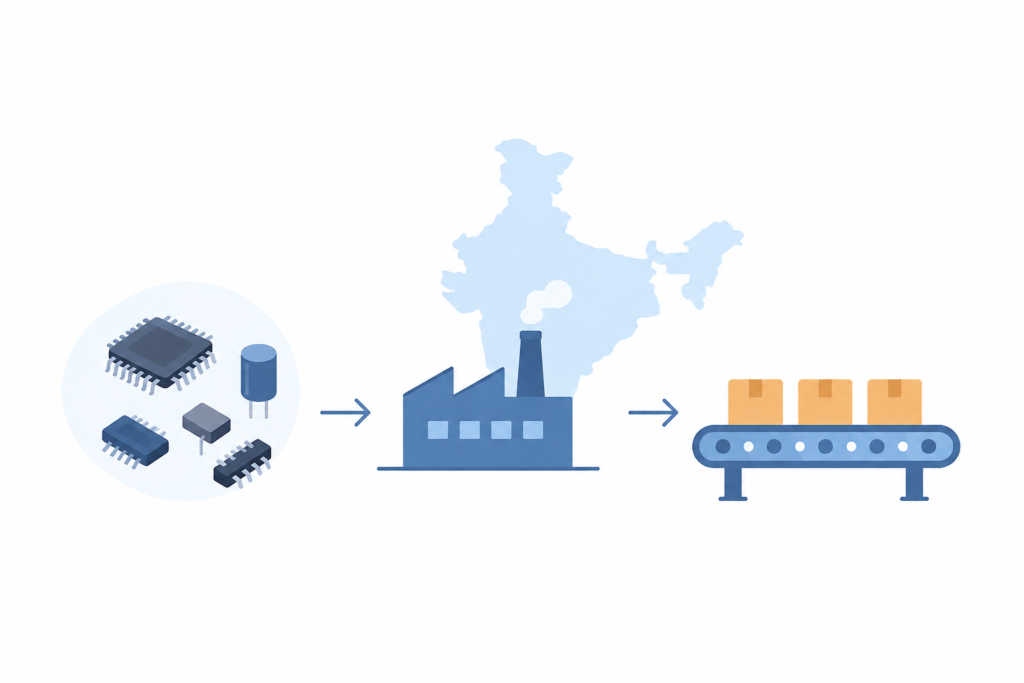
Localized manufacturing means producing or sourcing parts, components, or finished products closer to the market where they’re used – instead of relying on a single distant supplier.
Companies do this three ways:
- Local supplier development – qualifying manufacturers in the target region
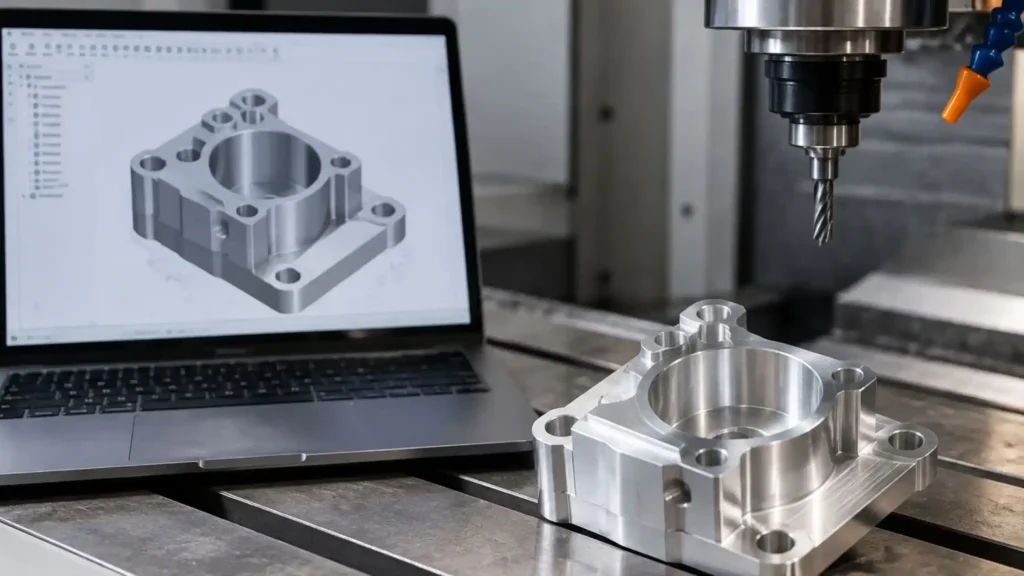
- Component localization – replacing an imported part with a locally made equivalent
- In-house localization – setting up owned production in the new market
Localization doesn’t mean abandoning global sourcing. Most manufacturers run a mixed model: critical or high-volume components local, specialized or low-volume components international.
Global value-chain trade made up 46.3% of global trade in 2026, and the WTO reports these chains are becoming more regional, not less (WTO Global Trade Outlook, 2026).
Why Localization Matters Right Now
Global manufacturing companies that depend on one country for a key component are exposed. A single port closure, tariff change, or supplier failure can stop a production line.
| Pain Point | How Localization Fixes It |
| Single-source dependency | Adds a qualified regional supplier as backup |
| Rising freight/import costs | Shortens the shipping distance and cuts duties |
| Long lead times | Regional suppliers replenish faster |
| Supply disruptions | Diversifies risk across multiple locations |
| Weak supplier collaboration | Local teams can visit, audit, and iterate faster |
The WTO names supplier and geographic diversification as a primary lever for supply chain resilience – not a nice-to-have.
How a Manufacturing Localization Strategy Works
A localization strategy is a staged process, not a one-time switch. The steps below apply whether you’re a single-site OEM or manage a network of chain manufacturers across your supply base:
- Identify target components – parts with long lead times, high freight cost, or single-source risk
- Assess feasibility – check specs, tolerances, volumes, and tooling requirements
- Shortlist suppliers – filter by capability, certifications, and quality systems
- Develop the component – review drawings, materials, and manufacturing method with engineering
- Build prototypes – validate dimensions, function, and fit
- Run production validation – confirm the supplier holds tolerance and quality at volume
- Scale to full production – lock in schedules, logistics, and performance monitoring
This applies to machined parts, fabrications, castings, forgings, and assemblies alike.
Component Localization in India
India has moved past “low-cost option” status. As of March 2026, the Production Linked Incentive (PLI) scheme has attracted ₹2.40 lakh crore (~$29 billion) in actual investment against a ₹1.91 lakh crore outlay across 14 sectors – generating 14.15 lakh jobs and ₹15.2 lakh crore in exports (Ministry of Commerce and Industry, March 2026).
Automobiles and auto components account for ₹44,326 crore of that investment, and specialty steel another ₹23,896 crore – the two sectors most relevant to OEMs localizing mechanical and structural components.
For a global OEM, component localization in India typically covers:
- Reviewing imported drawings and specs against Indian manufacturing capability
- Mapping local material grades to your specification
- Building and validating prototypes
- Running dimensional and quality checks against your standard
- Scaling production capacity
- Managing export documentation and logistics
Where Localization Happens: India’s Manufacturing Clusters
Capability isn’t spread evenly across India – it’s concentrated in specific industrial corridors, each with its own specialization:
| Cluster | Specialization | Common Certifications |
| Pune-Aurangabad-Nashik (Maharashtra) | Automotive and precision engineering | IATF 16949, ISO 9001 |
| Chennai–Oragadam-Sriperumbudur (Tamil Nadu) | Automotive and EV components | IATF 16949 |
| Coimbatore (Tamil Nadu) | Pumps, textile machinery, general engineering goods | ISO 9001 |
| Rajkot-Ahmedabad-Vadodara (Gujarat) | CNC machining and precision components – over 60% of India’s precision component exports | ISO 9001, IATF 16949 |
| Delhi-NCR | High-tolerance aerospace and defence components | AS9100, ISO 9001 |
| Bengaluru | Aerospace, defence, deep-tech precision engineering | AS9100, ISO 13485 |
India’s precision machining sector is valued at roughly $2.1 billion annually and growing 8-10% CAGR. CNC shop rates in these clusters typically run ₹800-2,500 per hour (about $9.50-$30 USD), and leading Tier-1 shops machine to tolerances as tight as 3 microns on critical features – competitive with, though not automatically cheaper than, equivalent Chinese suppliers on complex 5-axis work.
Which cluster fits depends on the component: Gujarat for high-volume CNC parts, Pune or Chennai for automotive-grade components needing IATF 16949, Bengaluru or Delhi-NCR for aerospace-grade tolerances.
Challenges to Plan For
Localization isn’t risk-free. These are the checks that separate a smooth transition from a failed one:
| Challenge | What to Verify |
| Supplier capability | Production capacity, technical depth |
| Quality | Inspection systems, process control |
| Material availability | Local grades match your spec |
| Tooling | Cost, ownership, lead time |
| Production volume | Supplier can scale with demand |
| Engineering changes | Compatibility with existing design |
| Certification | IATF 16949 (automotive), AS9100 (aerospace), ISO 13485 (medical devices), or plain ISO 9001 – confirm which one your program actually needs |
| Total cost | Landed cost, not just unit price |
A lower per-unit price means nothing if tooling, inspection, and logistics costs erase the savings. Evaluate total landed cost every time.
Localized Manufacturing vs. Global Sourcing
| Factor | Localized Manufacturing | Global Sourcing |
| Supplier location | Regional/domestic | International |
| Transport distance | Shorter | Longer |
| Lead time | Faster | Slower |
| Supplier diversity | Regional expansion | Wider global base |
| Logistics exposure | Lower | Higher |
| Market responsiveness | Faster | Requires more planning |
Most resilient supply chains run both models – local for speed and risk reduction, global for specialized capability or scale.
How to Start Localizing in India
Don’t localize your entire supply chain at once. Start with the components causing the most pain: long lead times, high freight cost, or repeated supply failures.
Evaluate Indian suppliers on:
- Manufacturing capability and engineering support
- Quality systems and certifications
- Production capacity and delivery performance
- Material sourcing and cost competitiveness
- Prototype turnaround and export readiness
A manufacturing partner with in-house engineering support removes the burden of qualifying and managing multiple suppliers yourself.
Why India Is Gaining Ground
The WTO’s February 2026 report identifies India as a direct beneficiary of Asia’s supply chain reorganization, as value chains become less concentrated and more regional.
This regional shift is backed by real capital, not just geography. High-efficiency solar PV modules alone drew ₹64,873 crore in PLI investment 0 the highest of any sector 0 followed by pharmaceuticals at ₹45,158 crore and automobiles/auto components at ₹44,326 crore (Ministry of Commerce and Industry, FY26). That capital is building the machining, tooling, and quality infrastructure that component localization depends on – not just cheaper labor.
How Venttup Supports Manufacturing Localization
Venttup helps global businesses localize engineering components through India, from initial assessment through full production:
Component Assessment → Engineering Development → Prototype → Validation → Supplier Qualification → Production
This covers component evaluation, reverse engineering, prototype development, and production scale-up – under one accountable partner instead of five separate vendors.
Key Takeaways
- Localized manufacturing means producing or sourcing components closer to the target market, not abandoning global sourcing entirely.
- India’s PLI scheme has drawn ₹2.40 lakh crore in actual investment (vs. a ₹1.91 lakh crore outlay) as of March 2026, with auto components alone accounting for ₹44,326 crore.
- Capability is concentrated in specific clusters – Gujarat for high-volume CNC work, Pune/Chennai for IATF 16949-certified automotive parts, Bengaluru/Delhi-NCR for AS9100 aerospace tolerances.
- Total landed cost, not unit price, is the number that determines whether localization actually saves money.
- A staged approach – starting with a small set of high-impact components – reduces risk versus localizing an entire supply chain at once.
Conclusion
Localized manufacturing gives global businesses a way to cut overseas dependency, shorten lead times, and build supply chain resilience – without abandoning international sourcing entirely.
The right approach combines local and global suppliers, chosen deliberately by component criticality and risk. For businesses evaluating India, the right engineering partner turns that strategy into an executable plan.
Looking to localize engineering components in India? Connect with Venttup to discuss your component development, sourcing, and manufacturing requirements.
FAQs
What is localized manufacturing?
Producing or sourcing components closer to the market where they’re used, instead of relying on distant single-source suppliers.
What is component localization?
Replacing an imported component with an equivalent developed and manufactured by a qualified local supplier.
What are the benefits of a manufacturing localization strategy?
Shorter lead times, lower logistics exposure, stronger supplier collaboration, and reduced dependency on any single overseas source.
Is localization the same as reshoring?
No. Reshoring returns production to a company’s home country. Localization can mean developing suppliers in any target market, including a third country like India.
Why is India suitable for component localization?
India has manufacturing depth across automotive, aerospace, defence, and industrial equipment, plus growing government support (PLI scheme) for domestic value addition.