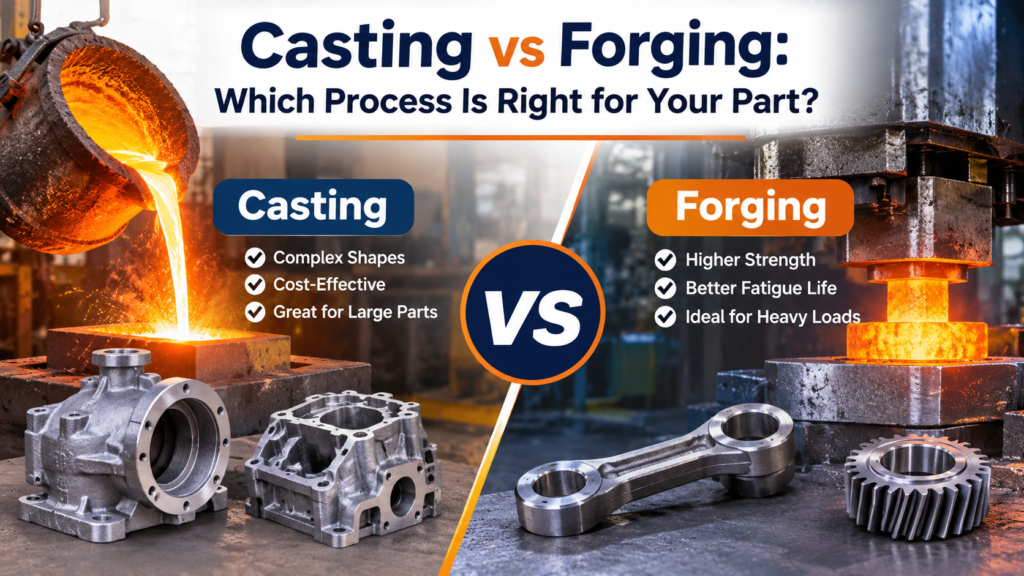
Choose forging when a part has to survive heavy, repeated or sudden loads. Choose casting when the shape is complex, has internal passages, or is too large to forge at a sensible cost. Most decisions come down to that rule, with production volume and total cost settling the close calls.
The wrong choice gets expensive later. A cast bracket that cracks in the field, or a forging that needed so much machining it cost twice the casting quote, usually traces back to a decision made on unit price alone.
This casting vs forging guide is for design engineers, sourcing teams and OEM buyers who have to make that call, or check a supplier’s recommendation.
Table of Contents
- Difference Between Casting and Forging
- Types of Casting and Forging Processes
- Is Forging Stronger Than Casting?
- Which Is Cheaper, Casting or Forging?
- Choosing the Right Process: When to Use Casting or Forging
- Casting and Forging Defects: Inspection and Quality Checks
- Casting and Forging Suppliers in India: Sourcing and Localisation
- How to Choose Between Casting and Forging: A 5-Step Checklist
- Frequently Asked Questions
- Key Takeaways
- Conclusion: Casting or Forging for Your Part?
Difference Between Casting and Forging
The main difference between cast vs forged parts is the state of the metal when it takes shape.
- What is casting? Casting is a manufacturing process in which metal is melted, poured into a mould cavity and left to solidify.
- What is forging? Forging is a manufacturing process in which solid metal is pressed or hammered between dies until it flows into shape.
How the Two Processes Compare
| Basis of difference | Casting | Forging |
| Working temperature | Above the metal’s melting point | Below the melting point: hot, warm or cold |
| Tooling | Patterns, sand moulds, cores, metal dies | Forging dies, hammers, presses |
| Internal channels | Formed directly with cores | Not possible; machined afterwards |
| Shape complexity | Very high: thin walls, undercuts, varying wall thickness | Moderate, limited by metal flow and die draft |
| Part size | From a few grams to many tonnes | Closed-die limited by press capacity; open-die suits very large parts |
| Surface finish and tolerances | Rough with sand casting, fine with investment and die casting | Moderate when hot forged, closer when cold forged |
| Lead time to first parts | Short with sand casting | Longer while dies are made |
| Alloy range | Almost any alloy, including grey cast iron, which cannot be forged | Most steels, stainless steels, aluminium and copper alloys, titanium |
Types of Casting and Forging Processes
Neither process is a single method. The variant your supplier proposes changes the tolerances, surface finish, tooling cost and minimum order quantity, so it is worth knowing the main options before you compare quotes.
Casting Methods: Sand, Investment, Die and Centrifugal
| Method | How it works | Best suited to | Common materials |
| Sand casting | Metal is poured into a packed sand mould that is broken away after each pour | Large parts, low to medium volumes, pump and valve bodies | Grey iron, SG (ductile) iron, carbon steel, aluminium |
| Investment (lost-wax) casting | A wax pattern is coated in ceramic, the wax is melted out, and metal fills the shell | Small, detailed parts that need a fine finish and close tolerances | Stainless steel, alloy steel, nickel alloys |
| High-pressure die casting | Molten metal is injected into hardened steel dies at high pressure | Thin-walled housings and covers made in large numbers | Aluminium, zinc, magnesium |
| Gravity die (permanent mould) casting | Metal is poured into reusable metal moulds under gravity | Medium volumes where better properties than sand are needed | Aluminium, copper alloys |
| Centrifugal casting | The mould spins as metal is poured, throwing it outward against the wall | Pipes, bushes, rings and cylinder liners | Cast iron, bronze, steel |
Forging Methods: Open-Die, Closed-Die, Ring Rolling and Cold Forging
| Method | How it works | Best suited to | Common materials |
| Open-die forging | The workpiece is shaped between flat or simple dies and repositioned between blows | Large shafts, blocks and low volumes | Carbon steel, alloy steel, stainless steel |
| Closed-die (impression-die) forging | Metal is pressed into shaped die cavities, and the excess escapes as flash | Connecting rods, gear blanks, flanges and other medium to high volume parts | Carbon and alloy steel, aluminium, titanium |
| Seamless rolled ring forging | A pierced blank is rolled into a ring that grows in diameter | Bearing races, slewing rings, large flanges | Carbon steel, alloy steel, stainless steel |
| Upset forging | The end of a heated bar is compressed to increase its diameter | Bolt heads, valve stems, axle ends | Carbon and alloy steel |
| Cold forging | Metal is formed at or near room temperature | Small, high-volume parts with a good surface finish, such as fasteners and pins | Low-carbon steel, aluminium, copper |
Hot forging is carried out above the metal’s recrystallisation temperature, which for most steels means well above 900 °C. At that heat the metal stays workable and does not harden as it deforms. Cold forging skips the heating but needs much more force.
Is Forging Stronger Than Casting?
For the same alloy, a sound forging is stronger, tougher and far more resistant to fatigue than a casting. Three things account for the gap.
- No solidification defects. As a casting cools, it can develop shrinkage cavities and gas porosity. These tiny voids act as stress raisers, and fatigue cracks tend to start there. Forging squeezes the metal and closes up voids left in the original billet.
- Continuous, refined grain flow. Cast metal forms a dendritic grain structure that grows in random directions as it solidifies. Forging breaks that structure down and lines the grain up along the shape of the part, which pays off most under cyclic and impact loading.
- Better ductility and impact toughness. Forged steel typically shows higher elongation and higher Charpy impact values than cast steel of a similar composition, so it bends before it breaks.
None of this makes castings weak. A well-designed casting in the right alloy, properly heat treated and inspected, carries serious loads in heavy machine frames and high-pressure valve bodies every day. For critical castings, hot isostatic pressing (HIP) can also close internal porosity. Forging simply gives you more safety margin when fatigue or shock is the main risk.
Grain flow does come with one catch. Forged parts are anisotropic, meaning they are strongest along the grain and weaker across it. A good forging design points the grain along the main load path.
Which Is Cheaper, Casting or Forging?
Casting usually wins on upfront cost and on complex or low-volume parts. Forging often wins on cost per part at higher volumes.
The common mistake is comparing raw quotes. Compare the cost of a finished, inspected part delivered to your line instead. These are the items that move that number:
- Tooling. Sand casting patterns are inexpensive and simple to change. Closed forging dies are machined from hardened tool steel and cost much more, though they last for many thousands of parts.
- Volume. Die cost is spread across the order. On a small batch it can dominate the price of each part; on a long run it fades into the background.
- Material yield. A casting can be poured close to the final shape. A forging loses metal to flash and often carries a larger machining allowance, which hurts most with costly alloys like stainless steel or titanium.
- Machining. Count every CNC hour after forming. A cheap forging that needs heavy machining can end up dearer than a near-net casting.
- Inspection and rejections. Critical castings may need radiography on every piece. Allow for rejection rates too, especially defects that only show up after expensive machining.
When your design allows either route, ask suppliers to quote both. Base the quote on your real annual volume and a finished, inspected part. The answer is often not the one you expected.
Weighing two quotes right now? Send Venttup your drawing and annual volume. We will compare casting and forging on finished-part cost, not just the first price. Get a side-by-side quote
Choosing the Right Process: When to Use Casting or Forging
Match your part against these signals. Most parts fit one list clearly.
When Casting Is the Better Choice
- The part has internal channels, cavities or thin walls that a die cannot form.
- It is large or heavy, such as a machine base, turbine casing or large valve body.
- Loads are mostly static or moderate, without heavy shock.
- You need low tooling cost for prototypes or a few hundred pieces.
Venttup’s casting capability covers sand, investment and pressure die casting.
When Forging Is Better Than Casting
- The part takes cyclic, torsional or impact loads, as crankshafts, axles and rail bogie parts do.
- A failure would be a safety risk or cause costly downtime.
- The shape is solid and fairly simple, without enclosed cavities.
- Volumes are high enough to pay back the dies, or open-die forging suits a large one-off.
See Venttup’s forging capability for open-die, closed-die and cold forging.
Alternatives to Casting and Forging
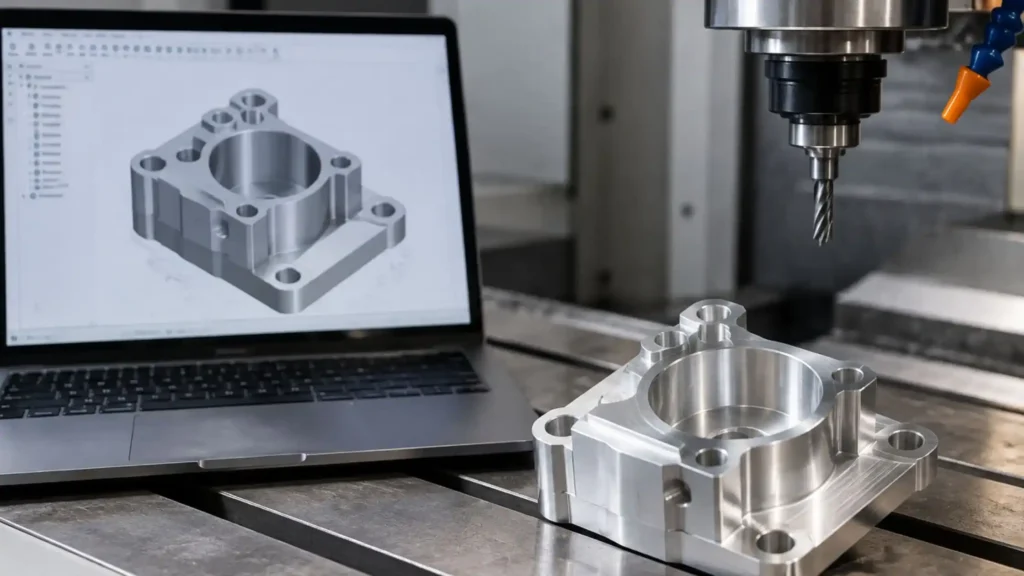
Sometimes the right answer is neither. For prototypes and very small batches, CNC machining from bar or plate avoids tooling altogether. Large structures can often be fabricated and welded. Many production parts are hybrids: forged or cast close to shape, then machined to final tolerance.
One case comes up often in localisation projects: converting an imported casting into a forging. It can raise strength and cut rejections, but it means redesigning for draft angles, removing enclosed cavities and re-qualifying the part. A new part development process keeps that conversion controlled from feasibility to production.
Casting and Forging Defects: Inspection and Quality Checks
A clear inspection plan protects you more than the process name on the purchase order. Both routes have their own typical defects, and each has a standard way to find them.
| Defect | Process | How it is usually detected |
| Gas porosity and shrinkage cavities | Casting | Radiography (X-ray), ultrasonic testing |
| Sand or slag inclusions | Casting | Radiography, inspection of machined faces |
| Cold shuts and misruns | Casting | Visual inspection, dye penetrant testing |
| Laps and folds | Forging | Magnetic particle inspection, dye penetrant testing |
| Internal bursts and cracks | Forging | Ultrasonic testing |
| Poor grain flow | Forging | Macro-etch test on a sectioned sample |
Beyond defect checks, ask for these before you approve a supplier:
- Material test certificates showing chemical composition and mechanical results: tensile strength, yield strength, elongation, hardness and, where relevant, Charpy impact values.
- Heat treatment records, such as normalising or quenching and tempering.
- Dimensional reports, ideally from a CMM, plus first article inspection for new parts.
- PPAP documentation if you supply the automotive industry.
Write the material standard on the drawing, not just the grade name. Piping is a good illustration: ASTM A105 covers forged carbon steel flanges and fittings, while ASTM A216 WCB covers cast carbon steel valve bodies. The same split exists in stainless steel with ASTM A182 (forged) and ASTM A351 (cast). Equivalent EN and IS (BIS) standards apply to many parts made for the Indian market.
Casting and Forging Suppliers in India: Sourcing and Localisation
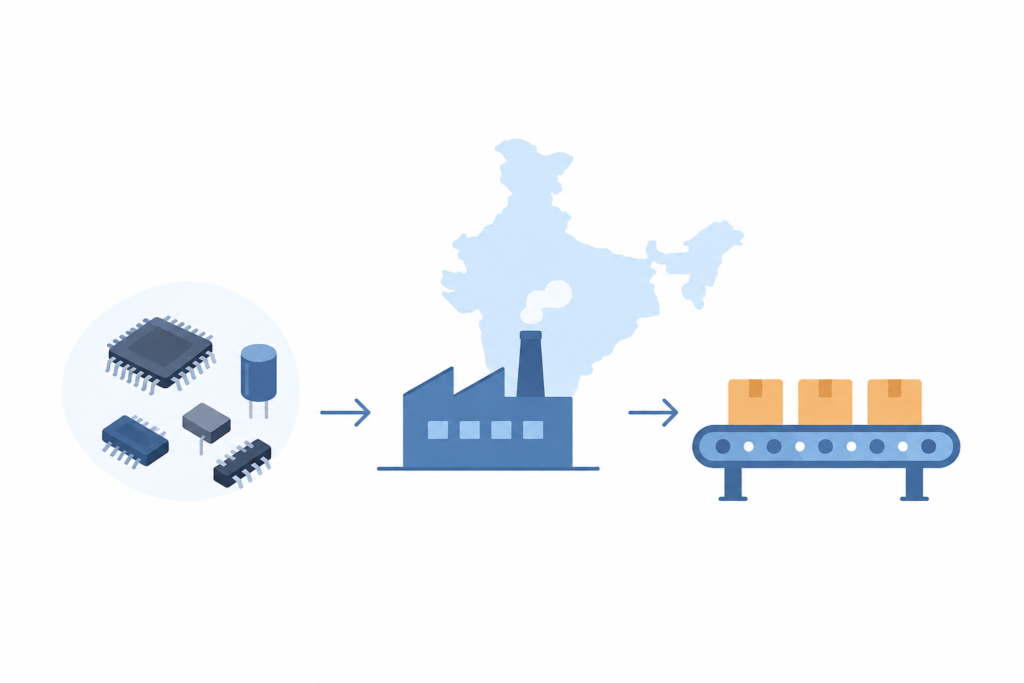
India is one of the world’s largest producers of castings and has a deep base of forging capacity, which makes it a strong option for buyers following a China Plus One strategy. Foundries cluster in centres such as Coimbatore, Kolhapur, Belagavi and Rajkot, while Pune and Ludhiana are well known for forging.
For Indian OEMs bidding on public tenders, localising critical cast and forged parts also raises local content under Public Procurement (Make in India) preferences.
Venttup handles this as a structured project rather than a one-line quote:
- A feasibility check of your drawing or sample, under NDA.
- A process recommendation (casting, forging, machining or a hybrid) based on loads, volume and total cost.
- Selection and qualification of the right foundry or forge from Venttup’s supplier network.
- Pilot production, prototype testing and documentation.
- A move to mass production with ongoing supplier performance tracking.
If you are replacing an imported component, Venttup’s indigenisation and localisation service and reverse engineering service take you from a sample part to a qualified Indian source.
[EDITOR: Add a real Venttup project here before publishing.] Include the industry, the part, the original process and source country, what Venttup changed, and measurable results such as lead time cut, cost difference or rejection rate. Get the client’s approval or anonymise it. Do not publish with invented figures.
How to Choose Between Casting and Forging: A 5-Step Checklist
Answer these five questions about your part, then match the answers to the signals in the section on when to use each process. If they pull in different directions, a manufacturability review pays for itself.
- What loads will the part see? List static, cyclic and impact loads, plus the operating temperature.
- Which features are non-negotiable? Mark internal passages, thin walls, undercuts, and the overall size and weight.
- Which alloy does the application need? Check that the grade is made in the form you are considering.
- What is your annual volume and product life? You need both numbers to compare quotes fairly.
- How will quality be proven? Agree on NDT methods, test certificates and acceptance criteria, and add them to the drawing.
Frequently Asked Questions
Forged steel vs cast steel: which is better for valves and flanges?
Forged steel is the usual choice for flanges, fittings and smaller valves in high-pressure service. Cast steel suits larger valve bodies whose internal flow paths would be impractical to forge.
Is die casting the same as forging?
No. Die casting injects molten metal into a steel die, while forging presses solid metal between dies. The shared word “die” is where the confusion starts.
What is squeeze casting?
Squeeze casting sits between the two processes. Molten metal is poured into a die and then solidifies under high pressure, which cuts porosity and brings its properties closer to a forging. It is used mainly for aluminium parts such as automotive suspension components.
Is cast iron the same as cast steel?
No. Cast iron contains more than about 2% carbon, which makes it easy to cast, but most grades are far less ductile than steel. Cast steel has much less carbon, so it is tougher and better suited to parts that take shock loads.
Key Takeaways
- Forging gives the stronger, more fatigue-resistant part; casting gives the freedom to make complex and very large shapes.
- Judge cost on a finished, inspected part at your real volume, not on the first quote.
- Check machining, fabrication and hybrid routes before committing to either process.
- Fix the material standard, NDT method and acceptance criteria before asking for quotes.
Conclusion: Casting or Forging for Your Part?
The right process comes from the part’s loads, geometry and real production volume, not from the lowest first quote. Bring your supplier in early, while the design can still change.
Not sure which process suits your part? Share your drawing, sketch or sample with Venttup. Our engineers will review it under NDA and recommend casting, forging or another route, with a quote based on your real production volume. Request a free process review.