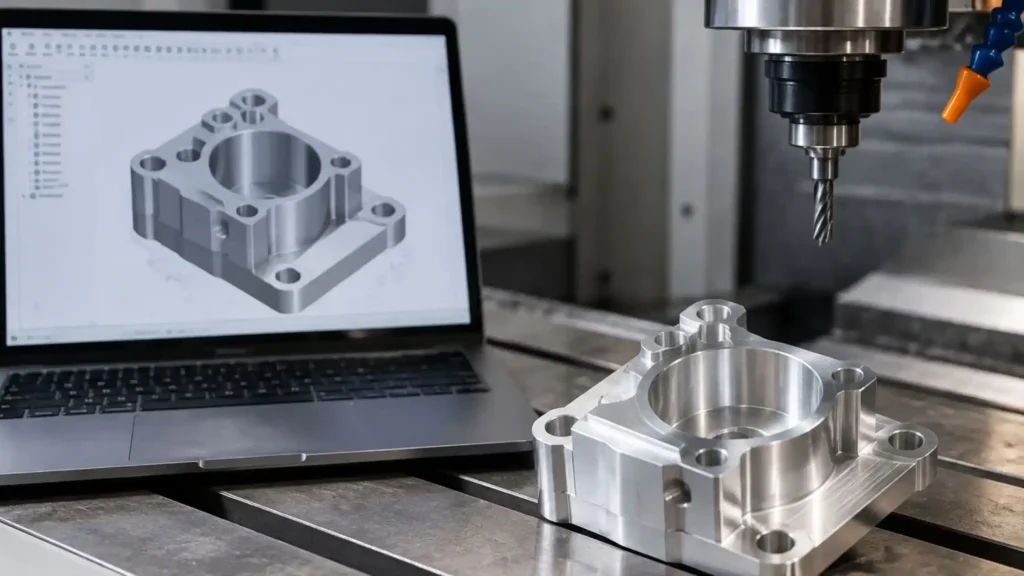
Engineering tighter tolerances and better surface finish into a critical shaft-sealing component
Casting Process: Shell Moulding | Component: Stuffing Box | Product Code: 641116157
Overview
The stuffing box is a critical shaft-sealing component used in centrifugal pumps, compressors, and other rotating machinery. Its function depends on tight geometric control around the bore, face, and flange – any inconsistency in these surfaces directly affects sealing performance, shaft alignment, and equipment life. This case study examines how the shell moulding casting process was applied to manufacture a precision stuffing box, and the dimensional, metallurgical, and cost advantages this process delivers over conventional sand casting.
The Challenge
Shaft-sealing components such as stuffing boxes present a specific manufacturing challenge: they require a combination of dimensional accuracy, fine surface finish, and consistent metallurgical structure that is difficult to achieve economically with conventional green-sand casting. Typical issues in conventional casting routes include:
- Wider dimensional tolerances, requiring extensive machining allowance on the bore, face, and flange
- Rougher as-cast surface finish, adding secondary finishing operations and cost
- Inconsistent grain structure and higher porosity, which can compromise strength and long-term sealing performance
- Batch-to-batch variability that complicates quality control on medium-to-high volume orders
For components used in pump and rotating-equipment applications – where leak prevention and shaft alignment are non-negotiable – these limitations translate into higher rejection rates, longer lead times, and increased finishing cost.
The Solution: Shell Moulding
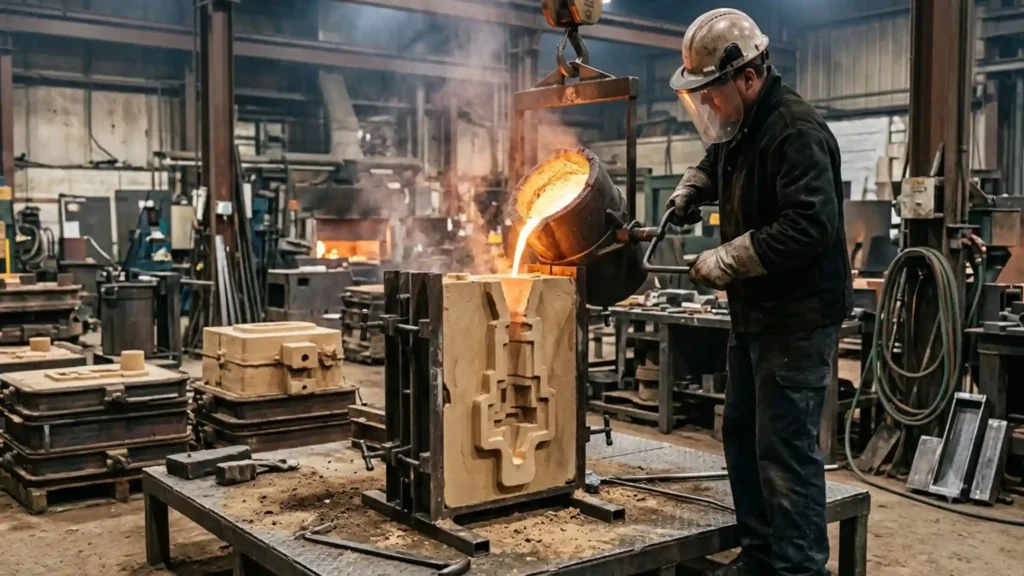
Shell moulding was selected as the casting route for this stuffing box because it directly addresses the tolerance and finish limitations of conventional sand casting. The process uses a resin-coated sand shell to form the mould, producing a rigid, dimensionally stable cavity that replicates fine detail with high repeatability.
This manufacturing process was used to create a stuffing box with a accurately machined bore for shaft sealing and an integrated flange, meeting the customer’s design drawings and specifications.
Why Shell Moulding Was the Right Fit
- Finer grain structure, improving strength and wear resistance in service.
- Reduced porosity and fewer casting defects compared to conventional sand casting.
- Closer as-cast tolerances, reducing the machining allowance needed on the bore, face, and flange.
- Consistent quality across batch production, supporting repeatable dimensional accuracy order after order.
- A process suited to medium-to-high volume production runs without sacrificing precision.
Technical Specifications
| Parameter | Detail |
| Casting Process | Shell Moulding |
| Material | Grey Cast Iron / SG Iron |
| Surface Finish | Fine, uniform |
| Dimensional Tolerance | Close tolerance (CT-based, per customer drawing) |
| Application | Shaft sealing in pumps, compressors, rotating equipment |
| Machining | Bore, face & flange machined to customer specification |
| Customization | Available in various sizes as per drawing/sample |
Process Advantage
Compared with conventional sand casting, shell moulding delivers a finer surface finish and closer tolerances on the as-cast component. Producing the casting close to its final dimensions minimizes machining requirements, reducing cycle times for the bore, face, and flange while improving dimensional consistency and lowering rejection rates. The result is a component that moves from mould to finished part with fewer downstream corrections, which is particularly valuable for pump and rotating-equipment builders working to tight delivery schedules.
Outcome
The finished stuffing box met the dimensional accuracy and surface-finish requirements needed for reliable shaft sealing in pump and rotating-equipment applications, while the shell moulding process kept post-casting machining and finishing to a minimum. The uniform grain structure achieved through shell moulding supports the strength and durability the component needs over its service life, and the repeatability of the process supports consistent quality across ongoing batch production.
Applications
- Centrifugal pumps
- Industrial process pumps
- Compressors
- Other rotating equipment requiring reliable shaft sealing and leak prevention
Key Takeaways
- Shell moulding is well suited to precision, shaft-sealing components where tolerance and surface finish directly affect performance.
- Closer as-cast tolerances reduce machining allowance, cost, and lead time relative to conventional sand casting.
- A finer, more uniform grain structure improves strength, wear resistance, and long-term reliability.
- The process scales cleanly from prototype quantities to medium-to-high volume production while holding consistent quality.